


Natural Resources Canada
www.nrcan.gc.ca
Common menu bar links
Office of Energy Efficiency Links
Personal: Residential
Menu
Improving Energy Performance in Canada – Report to Parliament Under the Energy Efficiency Act For the Fiscal Year 2005-2006
PDF VersionNext Page
Table of Contents
Chapter 7: Renewable Energy
Renewable Energy Use
In 2004, renewable energy generation capacity from renewable sources accounted for approximately 62 percent of total Canadian electricity capacity (see Table 7-2). Most of the renewable energy used in Canada comes from either hydro-electricity or thermal energy from biomass such as wood-waste sources.
Hydro-Electricity
Hydraulic power is a renewable energy based on the water cycle – evaporation, precipitation and flow of water toward the ocean. Canada has abundant water resources, and its geography provides many opportunities to produce low-cost energy. Tapping the energy from moving water has played an important role in the economic and social development of Canada for the past three centuries.
In 2004, hydro power accounted for about 59 percent of Canada's total electricity generation. Small-scale hydroelectric projects, with a capacity of 50 megawatts (MW) or less, constitute about 2.5 percent of Canada's electricity-generating capacity. Small-scale hydro has considerable potential for increased production.
Biomass
Bioenergy is a renewable source of energy derived from organic substances known as biomass. Biomass is supplied by agricultural wastes (such as chaff, straw, grain screenings, husks and shells, food-processing residues and methane) and forestry wastes (such as logging slash, sawdust, black liquor from the pulping process and other industrial waste). Other biomass supplies include animal litter and manure, dedicated feedstocks from agriculture and forest origin, landfill gas methane, urban wastes to be incinerated, and sewage for biogas. Bioenergy contributes about 6 percent of Canada's primary energy, mostly for industrial process heat, electricity generation and residential space heating. Corn and other agricultural products are also used to generate ethanol and biodiesels for the transportation market.
TABLE 7-1
| Electricity | Thermal Energy |
| Hydro-electricity | Biomass (e.g., roundwood, pellets, wood chips) |
| Tidal power | Ground-source heat pumps (e.g., earth energy) |
| Biomass (e.g., wood waste) | Solar air-heating systems |
| Biogas (e.g., methane from landfill sites) | Solar hot-water systems |
| Wind turbines | |
| Photovoltaic systems | |
| Mechanical Power | Transportation |
| Wind water pumps | Biodiesel |
| Ethanol from biomass | |
TABLE 7-2
| Year | Renewable electricity generation capacity (megawatts) |
Percent of total capacity |
| 1990 | 59 557 | 58 |
| 1991 | 61 116 | 58 |
| 1992 | 62 895 | 58 |
| 1993 | 63 114 | 56 |
| 1994 | 63 175 | 56 |
| 1995 | 66 542 | 57 |
| 1996 | 67 101 | 59 |
| 1997 | 68 202 | 61 |
| 1998 | 68 340 | 62 |
| 1999 | 68 686 | 62 |
| 2000 | 69 005 | 62 |
| 2001 | 68 734 | 61 |
| 2002 | 70 895 | 62 |
| 2003 | 72 160 | 62 |
| 2004 | 72 783 | 62 |
Bioenergy production represents Canada's second largest renewable energy source. Most bioenergy is produced from organic refuse and used with the facilities in which the energy conversion takes place. The pulp and paper industry produces and uses most of Canada's bioenergy. Industrially produced heat and electricity, independent power producers' electricity, electricity from urban wastes and residential wood heat are all considered commonplace in Canada's energy mix.
Home heating with wood usually takes the form of standalone wood stoves, wood furnaces with hot-water or forced-air systems, fireplaces with advanced combustion inserts, high-efficiency fireplaces or high-thermal-mass masonry heaters. About 3 million Canadian households use wood for home heating. Canadians usually prefer roundwood, but alternatives include wood chips and pellets.
Earth Energy
As a result of the sun heating the surface of the planet, the temperature of the earth that is one or two metres below the surface remains fairly constant – between 5°C and 10°C. This is warmer than outside air during the winter and cooler than outside air in the middle of summer. A ground-source heat pump takes advantage of this temperature difference by using the earth or the ground water as a source of heat in the winter and as a "sink" for heat removed from indoor air in the summer. For this reason, ground-source heat pumps are known as earth energy systems (EESs).
During winter, EES installations remove heat from the earth using a liquid, typically an antifreeze solution, that circulates within an underground loop. It then upgrades the heat with a conventional heat pump and transfers it to indoor space or the water-heating system. During summer, the system reverses this process to operate as an air conditioner. EES installations supply less than 1 percent of the market for space and water heating and cooling in Canada.
Wind Energy
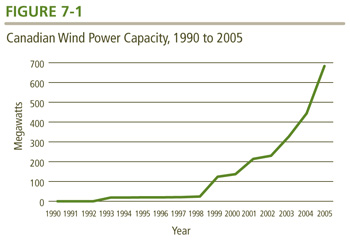
Wind turbines convert the kinetic energy of wind into electrical or mechanical energy. Canada's land mass and coastal waters combine to provide a wind resource with extraordinary potential. While Canada has not achieved the level of wind generation seen in other countries, recent policy developments have spurred record growth in the Canadian wind generation industry (see Figure 7-1). In 2004, wind energy accounted for about 0.3 percent of Canada's total electricity generation, up from 0.2 percent in 2003. Despite significant additions in recent years, wind energy contributed only 0.4 percent of the total electrical generating capacity in Canada in 2004.
Wind energy also provides mechanical power. Several thousand wind-powered water pumps are used throughout Canada, mostly in the Prairie provinces. As well, Canadians use small, residential-sized wind turbines to power cottages and remote houses.
Solar Energy
Three main technologies use energy from the sun:
- passive solar technologies – buildings are designed and located to maximize their reception of solar energy.
- active solar thermal systems – solar radiation is converted into thermal energy for heating air or water in residential, commercial and industrial applications.
- solar electric (photovoltaic) systems – solar radiation is used to produce electricity.
During the 1990s, Natural Resources Canada (NRCan) assisted a Canadian company in developing a perforated solar absorber to preheat ventilation air and reduce a building's fuel requirements for space heating. This technology is more cost-effective than conventional solar air-heating technologies and is gaining acceptance in Canada and abroad. Systems have been installed on industrial and commercial/institutional buildings throughout Canada.
Canada's total photovoltaic (PV) power installed capacity increased by 25 percent in 2005 to 17.6 MW from 14 MW at the end of 2004. Total PV module sales by Canada (domestic and export) were at 4.6 MW. The average market growth has been 25 percent annually since 1992. In 2005, jobs grew by 32 percent to 865 positions, with total revenues estimated at CAN$165 million, a 32 percent increase over 2004. Investments in research and development (R&D), manufacturing capacity, and acquisitions in PV-related business have not increased significantly over 2004, reaching a total of CAN$31 million, of which 30 percent were investments in R&D activities. The weighted average price of PV modules dropped to CAN$4.31 per watt in 2005, with a steady average decline of 12 percent per year since 1999. The total public (federal and provincial combined) R&D and demonstration budget reached CAN$6.7 million in 2005. Funding focused on technology and innovation with a 2025 horizon.
NRCan delivers several initiatives to increase the use of small-scale renewable energy in Canada. The following is the array of NRCan renewable energy programs.
Renewable Energy Programs: Wind Power Production Incentive (WPPI)
Objective: The WPPI is a 15-year, $260-million program to support the installation of 1000 MW of new wind energy capacity or the production of 2.6 terawatt hours by March 31, 2007.
The WPPI encourages electric utilities, independent power producers and other stakeholders to gain experience in wind power, an emerging energy source. The incentive is approximately $0.01 per kilowatt hour of production, and eligible recipients can receive the incentive on 10 years of production.
Key 2005-2006 Achievements
- Six new wind energy projects were commissioned in fiscal year 2005-2006: two are located in Ontario, two in Quebec, one in Saskatchewan and one in Manitoba. These projects contributed 436 MW of new wind energy capacity, and represent a total financial contribution over 10 years of more than $150 million.
- Since WPPI's introduction in 2002, about 670 MW of wind power capacity have been commissioned, representing 18 projects and a total financial commitment of $239 million.
For more information:
canren.gc.ca/wppi
Renewable Energy Programs: Initiative to Purchase Electricity From Emerging Renewable Energy Sources
Objective: To purchase electricity from emerging renewable energy sources (ERES) certified by a third party as having low environmental impact, with the objective of reducing greenhouse gas (GHG) and other air pollution emissions associated with federal electricity consumption.
Between 1998 and 2001, NRCan entered into three pilot projects to purchase electricity from ERES for federal facilities in Alberta, Prince Edward Island and Saskatchewan. The Government of Canada has pledged to purchase 20 percent of its electricity from ERES by 2010.
Key 2005-2006 Achievements
- About 90 gigawatt hours (GWh) of electricity from ERES were generated in Ontario through an agreement with Energy Ottawa.
- Also, 56 GWh of electricity from ERES continued to be generated for federal facilities in Alberta, Saskatchewan and Prince Edward Island, resulting in about 50 000 tonnes of GHG emissions reductions.
- Consultations took place in British Columbia, New Brunswick, Newfoundland and Labrador, and Nova Scotia.
For more information:
reed.nrcan.gc.ca
Renewable Energy Programs: Photovoltaic and Hybrid Systems Program
Objective: To support the development and application of solar PV technologies in Canada.
The program contributes to increasing the use of PV energy technologies in Canada by developing technologies and by facilitating the development of a Canadian-based globally competitive solar industry. It also contributes to the development of policies and programs. In collaboration with Canadian industry and universities as well as international energy research organizations, the program undertakes R&D activities and fosters information exchanges leading to the adoption of PV-hybrid systems that produce electricity from solar energy and another energy source; validates the performance and safety of utility-interactive inverter products; supports the development of building-integrated PV technologies and systems; and facilitates the development and adoption of harmonized standards and codes for PV systems in Canada.
Key 2005-2006 Achievements
- Collaborated with Concordia University on the development of a national research network on "solar buildings" that was approved in 2005. This will help build the scientific knowledge required to develop a zero-energy solar home and low-energy solar building optimizing daylighting, solar heat and solar electricity through an integrated design approach. The Solar Building Research Network now includes 10 universities and three government research centres.
- Partnered with PV manufacturers on projects that led to growth in the Canadian PV industry, employing over 900 people in 2005. These activities included R&D investments in the novel Spheral Solar Power Technology being developed by Automation Tooling System in Cambridge, Ontario, and novel power electronic products for PV-hybrid generation system being developed by XANTREX in Burnaby, British Columbia.
For more information:
cetc-varennes.nrcan.gc.ca/en/er_re.html
Renewable Energy Programs: Bioenergy Technology Program
Objective: To support efforts by Canadian industry to develop bioenergy technologies.
Technologies supported by this program include combustion, biochemical conversion of biomass to ethanol, thermochemical conversion of biomass to bio-oil and biogas, and biomass preparation and handling. Activities are directed toward improving the reliability and lowering the cost of technologies, disseminating information on technology feasibility and economics to potential users, and helping industry market its products in Canada and abroad.
Key 2005-2006 Achievements
- As the result of a major cost-shared project with NRCan, Iogen Corporation significantly improved the efficiency of the cellulose enzymes used in the company's process for producing fuel ethanol from cellulosic biomass. Iogen estimates that use of the more efficient enzymes will lower the cost of ethanol production from agricultural residues by 30 percent.
- NRCan supported the University of Toronto in developing an innovative technology to convert seed oils, waste grease, animal fats and tallow into high-quality biodiesel fuel. The technology uses mild reactor conditions to yield a superior biodiesel with significant reductions in capital and operational costs. BIOX Corporation of Oakville, Ontario, licensed the process and successfully operated a one-million-litresper-year pilot demonstration plant. BIOX, with Sustainable Development Technology Canada support, is opening a 60-million-litres-per-year commercial demonstration plant.
- Through NRCan R&D support, Canadian biomass companies such as Ensyn, Enerkem and Nexterra are moving their technologies toward commercialization. As a result of this support, many of these companies have moved to the next level of commercialization and are now in various stages of commissioning. Ensyn is commissioning a 70-tonne-per-day biomass pyrolysis biorefinery in Renfrew, Ontario. Nexterra is working with Tolko Industries, a forest products company, to set up a gasification process that will use Tolko's forest residues to replace natural gas in lumber kilns. Enerkem has completed a technology assessment program with the City of Edmonton for a municipal solid waste gasification project.
Renewable Energy Programs:
Renewable Energy Deployment Initiative (REDI)
Objective: To stimulate the demand for renewable energy systems by helping the supply industry in its marketing and infrastructure development efforts, including the provision of financial incentives.
REDI targets four systems: solar water heating, solar air heating and cooling, earth energy, and high-efficiency, low-emission biomass combustion. REDI promotes these systems in the business, federal and industrial markets through various means: a financial incentive, industry infrastructure development, a partnership with a utility coalition, market assessment, and information provision and awareness-raising activities.
Key 2005-2006 Achievements
- Experienced a record level of interest, completing 134 projects and receiving its 800th application (see Table 7-3). Published two important market documents: The REDI Strategic Business Plan to March 2007 and A Survey of Active-Solar Thermal Collectors, Industry and Markets in Canada.
- Oversaw four solar domestic water-heating pilot projects in regions across Canada.
- Completed a successful $4-million, multi-year partnership with the Canadian Geo-Exchange Coalition to promote ground-source heat pumps in Canada.
For more information:
nrcan.gc.ca/redi
TABLE 7-3
| Fiscal year |
Number of projects completed |
Estimated GHG reduction (tonnes CO2/yr.) |
Client investment | Federal incentive |
|---|---|---|---|---|
| 1998 | 8 | 2 869.0 | $1,306,295 | $145,950 |
| 1999 | 9 | 260.8 | $479,633 | $119,910 |
| 2000 | 24 | 5 825.4 | $1,849,918 | $327,078 |
| 2001 | 43 | 21.7 | $5,827,561 | $1,197,965 |
| 2002 | 33 | 5 718.8 | $2,745,834 | $606,210 |
| 2003 | 89 | 39 653.5 | $22,356,375 | $2,551,845 |
| 2004 | 65 | 47 447.0 | $11,200,942 | $2,250,421 |
| 2005 | 134 | 34 060.3 | $27,588,936 | $4,014,779 |
| Total | 405 | 135 856.5 | $73,355,494 | $11,214,158 |
Renewable Energy Programs:
Renewable Energy Technologies (RET) Program
Objective: To promote energy diversity and support efforts by Canadian industry to develop renewable energy technologies.
The Renewable Energy Technologies (RET) Program aims to improve the economics and efficiency of renewable energy technologies, including wind energy, small hydro (less than 20 MW), and thermal solar. It is actively involved in R&D to support the growth of the renewable energy industry in Canada. Growth will be achieved by:
- identifying and accelerating strategic R&D, development and deployment activities
- fostering the commercialization of new technologies
- identifying and developing opportunities for renewables integration
- developing infrastructure to support innovation, such as codes, policies and standards
- developing linkages between utilities, industry and academia
- conducting resource assessments
- supporting training and education
- disseminating results and findings
- supporting policy and programs
- engaging in international cooperation through the International Energy Agency
Key 2005-2006 Achievements
- Construction began in 2005 on the Drake Landing Solar Community, a 52-home subdivision in Okotoks, Alberta, south of Calgary. This seasonal solar thermal storage project, designed and led by CANMET Energy Technology Centre (CETC), will capture solar energy in the summer and store it for use in the winter. The solar district heating system will meet 90 percent of the community's residential space heating needs, a result unprecedented anywhere in the world. In November 2005, the project was awarded a Gold Award by the United Nations at the International Awards for Liveable Communities in Spain. It was also recognized as the Best New Idea of 2005 at the Annual Awards Gala held by the Calgary Home Builders Association.
- NRCan played a major role in establishing the Laval Hydro Turbine Industry Research Consortia in partnership with the Natural Sciences and Engineering Research Council of Canada, major Canadian hydro-turbine manufacturers and utilities. The facility is centred at the Laval University Hydraulic Machinery Laboratory (LAMH). The LAMH is a leading independent hydro turbine R&D facility in North America, and it has grown through the steady support of the RET Program. It will address the shortcomings in efforts to develop a strong Canadian R&D centre in the hydroelectric field by validating new, higher-efficiency hydro turbine designs.
- NRCan played a key role in the successful installation of the first-ever Wind-Diesel Integrated Control System (WDICS) on Ramea Island, Newfoundland and Labrador. The system consists of six 65-kilowatt wind turbines that will produce about 1 million kilowatt hours of electricity per year. The electricity will be fed to the local grid and will provide about 17 percent of Ramea's electrical load, while reducing carbon dioxide (CO2) emissions by 750 tonnes per year. WDICS, a sophisticated control system for the integration of wind and diesel power generation, was developed with the support of CETC-Ottawa at the Atlantic Wind Test Site.
For more information:
canren.gc.ca
Renewable Energy Programs: Market Incentive Program (MIP)
Objective: The MIP was a $25-million program to stimulate emerging markets for renewable electricity.
Under the program, electric utilities, retailers and marketers submitted proposals for consideration by NRCan and Environment Canada for projects to develop market-based programs and promote the sale of electricity from emerging renewable sources, having low environmental impact, to residential and small-business customers. The Government of Canada provided a short-term financial incentive of up to 40 percent of the eligible costs of an approved project, to a maximum contribution of $5 million per recipient.
The program's CO2 reduction objectives were 1.4 megatonnes per year by 2010.
Key 2005-2006 Achievements
- Agreement with SelectPower contributes to almost 1 million kilowatt hours of electricity from wind input into the Ontario energy supply, and information provided to consumers on small wind, solar and earth energy.
- TransAlta developed a Green Power Marketing Tool Kit for use by utilities and green power sellers.
- This program was completed on March 31, 2006, as per the original program framework.
For more information:
reed.nrcan.gc.ca
Renewable Energy Programs: Canadian Biomass Innovation Network (CBIN)
Objective: To develop sustainable and cost-effective technologies in bioenergy, biofuels, bioproducts and industrial bioprocesses for market acceptance, utilizing biomass resources in a sustainable and responsible way.
The Canadian Biomass Innovation Network (CBIN) supports strategic R&D in the areas of bioenergy, biofuels, bioproducts and industrial bioprocesses to displace Canada's fossil fuel energy consumption; directly or indirectly reduce GHG emissions; and seed the sustainable development of Canada's bio-based economy.
CBIN is a horizontal program developed and managed by five federal departments: Agriculture and Agri-Food Canada, Environment Canada, Industry Canada, National Research Council and Natural Resources Canada. The network coordinates and manages two federal government bio-based R&D initiatives:
- PERD "Bio-Based Energy Systems and Technologies" POL program
- Biotechnology R&D component of the new "Technology and Innovation (T&I)" Initiative
Key 2005-2006 Achievements
- In 2005, the Municipality of Boisbriand founded the CERVEAU (Centre d'expérimentation et de recherche sur les végétaux pour l'environnement et l'aménagement urbain), a non-profit organization dedicated to the development and the promotion of the use of fast-growing tree and shrub species for environmental ends. The municipality put forward public funds to acquire several hectares of land on its territory. This land was then changed from its original residential vocation to plantation sites.
- Optimization of operating parameters could lead to increased efficiency and reduced criteria emissions. Paprican has developed a boiler optimization protocol and, to test the protocol, has performed trials on 10 wood waste fired boilers for baseline testing and optimized 7 units with an average increase in steam from wood waste of over 20 percent with a dramatic decrease in CO2 emissions and carbon in ash. The results have created great interest from many other facilities wishing to participate.
- Successful production of first-generation materials based on wheat and pea starches. Different families of blends with bio-based polylactic acid and polycaprolacone are fully biodegradable and offer a full range of properties depending on the starch and plasticizer content. A number of film, sheet and molded prototypes have been produced using conventional plastic processing equipment to demonstrate the feasibility and potential of these materials for the fabrication of consumer products.
For more information:
cbin.gc.ca
