Natural Resources Canada
www.nrcan.gc.ca
Common menu bar links
Office of Energy Efficiency Links
Personal: Residential
Menu
Improving Energy Performance in Canada – Report to Parliament Under the Energy Efficiency Act For the Fiscal Year 2005-2006
PDF VersionNext Page
Table of Contents
Chapter 2: Equipment, Standards and Labelling
Introduction
Natural Resources Canada's (NRCan's) wide range of energy efficiency initiatives includes Canada's Energy Efficiency Regulations, standards and labelling programs.
The Energy Efficiency Act, which came into force in 1992, gives the Government of Canada the authority to make and enforce regulations on performance and labelling requirements for energy-using products that are imported into Canada or shipped across provincial borders for the purpose of sale or lease.
The first Energy Efficiency Regulations came into effect in February 1995, following extensive consultations with provincial governments, affected industries, utilities, environmental groups and others. The Regulations refer to national consensus performance standards developed by accredited standards writing organizations such as the Canadian Standards Association. Such standards include testing procedures that must be used to determine a product's energy performance. Regulated products that fail to meet the minimum performance levels identified by the Regulations cannot be imported into Canada or traded interprovincially.
Through the Accelerated Standards Action Program, NRCan works with key stakeholders to improve standards development and approval processes and accelerate the market penetration of high-efficiency residential, commercial and industrial equipment.
Regulations have now been established for more than 30 products that consume 71 percent of the energy used in the residential sector in Canada and 50 percent of the energy used in the commercial/institutional sector. Regulated products include major household appliances, water heaters, heating and air-conditioning equipment, automatic icemakers, dehumidifiers, dry-type transformers, electric motors of 1 to 200 horsepower and certain lighting products. The Regulations apply to these products even if they are incorporated into a larger unit or machine that is not regulated.
NRCan regularly amends the Regulations to strengthen the minimum energy performance requirements for prescribed products in situations where the market has been transformed to a higher level of efficiency. The Regulations are also amended occasionally to add new products, harmonize minimum energy performance requirements with those of other jurisdictions, and update testing methodologies or labelling requirements. Finally, regulations may be established for gathering market data on the energy performance of certain types of equipment. In the case of gas fireplaces, for example, the data gathered is used to support programs developed by the industry and NRCan and its partners for gas fireplace performance.
Before adding a new product or otherwise amending the Regulations, NRCan conducts studies to analyse how the proposed change will affect the market. For example, it checks if it will have a measurable impact on energy efficiency levels without imposing undue hardship on manufacturers. A key criterion for amending the Regulations is that the change must have a significant positive impact on consumers and the environment. Stakeholders are consulted on all proposed changes to the Act and Regulations as well as on their practical application in the marketplace. During the period covered by this report, for example, significant analysis and consultation was conducted on new proposed standards for vending machines and commercial refrigeration products, on increased stringency of standards for residential and commercial air conditioners, and on proposals for broadening the scope of standards for refrigerators and transformers. Other administrative revisions were also discussed with affected stakeholders.
Canada's Energy Efficiency Act and Energy Efficiency Regulations support a number of labelling initiatives designed to help consumers and commercial/industrial procurement officials identify and purchase energy-efficient equipment that will save them money and reduce greenhouse gas (GHG) emissions over the life of the product.
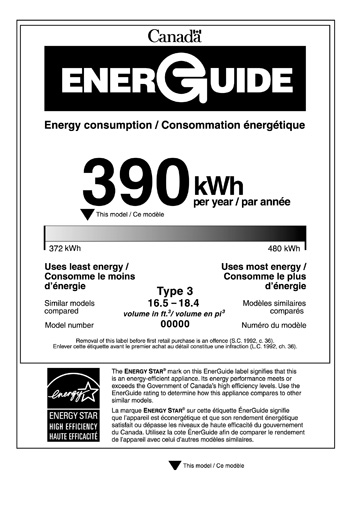
For example, the Act and the Regulations require that an EnerGuide label be displayed on major electrical household appliances and room air conditioners. For appliances, the EnerGuide label shows the consumer the estimated annual energy consumption of the product in kilowatt hours and compares it with the most and least efficient models of the same class and size. Labels for room air conditioners indicate the model's energy efficiency ratio and provide a comparative bar scale.
The EnerGuide label is also used voluntarily by manufacturers and suppliers of residential oil and gas furnaces, vented gas fireplaces, central air conditioners and air-toair heat pumps. In this case, the EnerGuide rating for a specific product (annual fuel utilization efficiency rating for oil and gas furnaces, fireplace efficiency rating for gas fireplaces and seasonal energy efficiency ratio for central air conditioners) is published on the back page of the manufacturer's brochure and includes a bar scale enabling consumers to compare the model with others of the same size and capacity.
The EnerGuide for Industry Program uses the EnerGuide name to encourage the use of more energy-efficient off-the-shelf industrial equipment, including equipment prescribed under Canada's Energy Efficiency Regulations. This equipment includes electric motors; dry-type transformers; heating, cooling and ventilation equipment; and certain lighting products. EnerGuide for Industry offers up-to-date product databases, Web-based applications and energy-use information that enable equipment buyers to compare the energy performance of various products and select the most energy-efficient model that meets their needs.
As well, the Regulations are consistent with and build on the ENERGY STAR® initiative in Canada. The internationally recognized ENERGY STAR symbol is a simple way for consumers to identify products that are among the most energy efficient on the market. Products that are prescribed in the Regulations and are also part of the ENERGY STAR initiative must meet levels of energy efficiency starting at 10 percent or more above the minimum performance levels set out in the Regulations in order to qualify for the ENERGY STAR symbol. As higher-performance products penetrate the market, ultimately their efficiencies become candidates for standard levels.
Standards
As a world leader in the use of energy efficiency standards, NRCan is committed to harmonizing federal standards and labelling requirements with those developed in other jurisdictions. Harmonization reduces barriers to trade and sustainable development by improving the flow of energy-efficient products within Canada and around the world, minimizes the regulatory burden on manufacturers, and avoids confusion for consumers.
For instance, the performance requirements in Canada's Energy Efficiency Regulations are similar to those in several Canadian provinces that regulate energy-using equipment manufactured and sold within their borders. Although NRCan works closely with provinces to ensure maximum harmonization of standards, in some cases provincial regulations may differ from the federal requirements or may apply to other types of energy-using equipment.
Due to the highly integrated North American market, Canada's energy performance requirements for many products are also similar to those regulated in the United States. As well, Canada's EnerGuide labelling requirements are coordinated with the U.S. EnergyGuide labelling program. Harmonization work is also undertaken through the North American Energy Working Group (NAEWG), established jointly by Canada, the United States and Mexico. During the report period, consultations with the NAEWG were initiated on developing a common North American approach to reducing "standby loss" in many electricity-using products.
The Asia-Pacific Economic Cooperation (APEC) organization is another important forum for regional cooperation on harmonization issues. Trade and investment liberalization and facilitation are high on the agenda of the APEC Energy Working Group (EWG). Among other initiatives, the EWG has been endeavouring to harmonize energy efficiency test methods and conformity assessment regimes of Asia-Pacific economies that use energy efficiency standards and labels as part of their environmental or energy programs. During the report period, Canada made a major contribution to maintaining the APEC standards information Web site.
NRCan also supports Canadian representation on committees of the International Organization for Standardization and the International Electrotechnical Commission as well as the national and international policy work of the Standards Council of Canada.
Compliance and Enforcement
The Energy Efficiency Regulations outline a number of responsibilities for dealers who import to Canada, or ship from one Canadian province to another, any prescribed energy-using product. NRCan is committed to securing voluntary compliance but can use a range of enforcement measures when necessary.
NRCan emphasizes self-monitoring, reporting, voluntary compliance and collaboration. However, the Energy Efficiency Act prescribes specific enforcement measures in cases where dealers violate the law. Enforcement activities include preventing products that do not meet the prescribed energy efficiency standard from entering Canada; preventing the sale or lease of non-compliant products in Canada; and fines. Violators can also be fined under the Administrative Monetary Penalty System of the Canada Border Services Agency (CBSA) for not providing required information on the prescribed product at the time of import; serious violations can be prosecuted.
To monitor compliance with the Regulations, NRCan captures information from two sources: energy efficiency reports and import documents. Section 5 of the Energy Efficiency Act requires that dealers provide energy efficiency reports when they first market a new product model. They provide NRCan with such information as the energy performance of each particular model, the name of the testing agency, the size category and other facts, as described in Schedule IV of the Regulations.
The Regulations require that, when importing a regulated product into Canada, dealers provide to CBSA officers specific product information on customs documents for all shipments (type of product, brand name, model number, name and address of dealer and purpose of import). Customs documents contain much less information than the energy efficiency report, but there is enough to allow NRCan to verify that there is a matching energy efficiency report. NRCan is then in a position to verify that all products entering Canada meet the required energy performance levels and to take action when necessary.
Key 2005-2006 Achievements
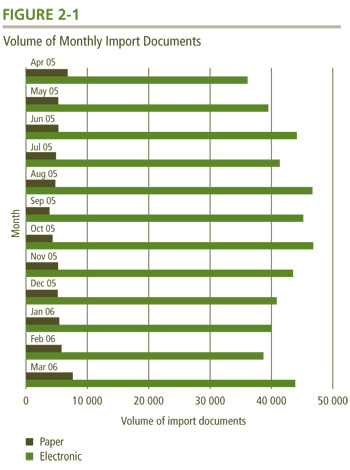
- NRCan processed over 570 108 records (records from April 1, 2005, to March 31, 2006) relating to the importation of regulated energy-using products to Canada in 2005–2006. Figure 2-1 illustrates the volume of import documents received in paper form and electronically per month over the 2005–2006 fiscal year.
- Over 95 877 new or revised model numbers were submitted to NRCan for entry into NRCan's equipment database (records from April 1, 2004, to March 31, 2005) from energy efficiency reports received from dealers.
Regulatory Impact to Date per Regulatory Impact Analysis Statement
In preparing amendments to the Regulations, NRCan analyses the impact of the proposed amendment on society, the economy and the environment. This information is made available through the Regulatory Impact Analysis Statement, which is annexed to the Regulations and published in the Canada Gazette, Part II.
As a result of Canada's minimum energy performance standards, it is estimated that an aggregate annual emissions reduction of 25.6 megatonnes will be achieved by 2010 (see Table 2-1). This is equivalent to taking 4 million cars off the road. The net benefit to consumers from just the latest amendment prescribing new standards for clothes washers, water heaters, chillers and exit signs is estimated to be $47 million by 2010. These benefits will continue to grow during the lifetime of the machines, which in some cases is 25 years.
TABLE 2-1
| Product (amendment number in brackets) | Energy savings (petajoules) | CO2 reductions (megatonnes) | ||
| 2010 | 2020 | 2010 | 2020 | |
| Residential appliances | 117.20 | 133.84 | 13.26 | 15.60 |
| Lamps – fluorescent/incandescent | 11.60 | 13.40 | 7.55 | 9.80 |
| Motors | 16.30 | 17.70 | 2.03 | 2.14 |
| Commercial HVAC | 6.40 | 7.50 | 0.43 | 0.57 |
| Refrigerators (5) | 4.92 | 10.96 | 0.49* | 1.10* |
| Ballast/room A/C, PAR lamps (6) | 3.96 | 9.44 | 0.39* | 0.94* |
| Clothes washers, domestic hot water, exit signs, chillers (8) | 16.20 | 42.67 | 1.29 | 3.61 |
| A/C, commercial refrigeration (draft 9) | 1.57 | 5.35 | 0.16 | 0.53 |
| Total | 178.15 | 240.86 | 25.60 | 34.29 |
* Values different from Regulatory Impact Analysis Statement due to emission factor change (using 99.3).
Labelling and Promotion
Since 1978, the EnerGuide label (see Figure 2-2) has given Canadians an opportunity to compare the energy consumption of one appliance with that of another. In 1995, with the introduction of the Energy Efficiency Regulations, placing an EnerGuide label on major electrical household appliances and room air conditioners became mandatory. Placing a label on a product before the first retail sale shows consumers how much energy a product uses, enabling them to consider the most energy-efficient purchase.

A voluntary EnerGuide rating program was established in 1997 and included gas furnaces, central air conditioners, heat pumps and oil furnaces. In the fall of 2003, coincident with the requirement in Canada's Energy Efficiency Regulations to test, verify and report on fireplace efficiency, gas fireplaces were added to the EnerGuide rating program, and manufacturers were asked to integrate EnerGuide fireplace efficiency ratings in their brochures. Since these products are typically purchased from a product brochure or catalogue, prescribing a label on the product would not be useful. Manufacturers are encouraged to include an EnerGuide rating in product brochures or catalogues, so consumers can compare the efficiency of the product when they are in the buying process. All major distributors of such products for sale in Canada report the verified energy performance rating of their products, as tested to the standards referenced in the Energy Efficiency Regulations. The verified energy performance rating submitted corresponds to the EnerGuide rating published in the brochures or catalogue. To date, manufacturers representing 85 percent of the products in the marketplace participate in the EnerGuide rating program and publish the ratings in their brochures. In addition, program participants must provide shipment data and aggregate energy efficiency information to track the progress of the program and identify marketplace improvements that could result from labelling.
EnerGuide directories with energy ratings for major appliances and room air conditioners are published each year and distributed to consumers, retailers and appliance salespeople. In fulfilling requests for information, electric utilities and provincial governments also distribute the directories. On-line directories published on the Office of Energy Efficiency Web site for all appliances and heating and cooling equipment are available and updated monthly.
Regularly conducted polls indicate that more than 50 percent of Canadians surveyed are aware of the EnerGuide label.
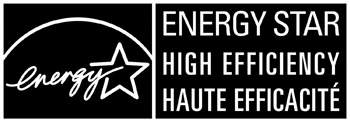
In 2001, responding to Canadians' desire for a labelling system designed to identify the best performers, Canada officially introduced ENERGY STAR, the international symbol for energy efficiency (see Figure 2-3). An agreement was signed with the U.S. Environmental Protection Agency and the U.S. Department of Energy. The Office of Energy Efficiency is the official custodian of the program for Canada. Canada became the fifth country to join the ENERGY STAR program, along with Australia, New Zealand, Japan and Taiwan. The European Union has adopted ENERGY STAR for office equipment.

ENERGY STAR establishes high efficiency criteria and levels for selected products for the residential and commercial sectors. Product categories are selected for the technical potential for high efficiency. This is a voluntary program. However, organizations must demonstrate that products meet the admissibility criteria and high performance levels endorsed by ENERGY STAR. For appliances and heating and cooling products, the criteria are based on the same test standards as those applied under the Energy Efficiency Regulations and are used to qualify products for the ENERGY STAR symbol.
Canada promotes specific product categories for which levels and criteria can be harmonized with those of the United States, including the following:
- Major appliances
- Heating, cooling and ventilation
- Consumer electronics
- Office equipment
- Windows and doors (Canadian levels)
- Selected lighting products (currently not fixtures)
- Selected commercial equipment
Canada has also integrated ENERGY STAR with the EnerGuide label for major appliances and room air conditioners to help consumers identify the best-performing products. While the EnerGuide label shows how much energy a product uses under normal conditions in one year, the ENERGY STAR symbol on the label identifies the most energy-efficient product. Now that industry-accepted standards of high efficiency have been established, ENERGY STAR has become the criterion to meet for incentive and rebate programs.
As part of the Government of Canada Action Plan 2000 on Climate Change, pilot projects were implemented in partnership with seven Canadian gas utilities and a nongovernment organization to address three major barriers to higher efficiency: awareness, accessibility to high-efficiency products and acceptance. From 2001 to March 2006, Canada cost-shared over 75 000 incentives to Canadian consumers for the purchase of high-efficiency, ENERGY STAR qualified gas-fired furnaces and boilers. The number of incentive-based installations represents approximately one quarter of the total gas furnace/boiler installations across Canada. The partners' contribution amounted to $15 million, and Canada's, $9.8 million. With NRCan's involvement, several utilities doubled the number of incentives and/or loan recipients that they would otherwise have disbursed without government participation or under their previous programs. The organizations also coordinated the delivery of coupons by manufacturers to complement the incentive. Canada's participation in this initiative also helped to increase the market penetration of high efficiency gas-fired furnaces and boilers and to widen the net of higher efficiency products to cover markets that traditionally support mid-standard-efficiency products.
ENERGY STAR was also used as the basis for sales tax rebates in British Columbia for heating and cooling equipment, and in Saskatchewan for the purchase of qualifying appliances (refrigerators, dishwashers, clothes washers and freezers) and furnaces and boilers. Organizations across Canada have used ENERGY STAR as a campaign driver to promote replacement with, or purchase of, higher-efficiency products.
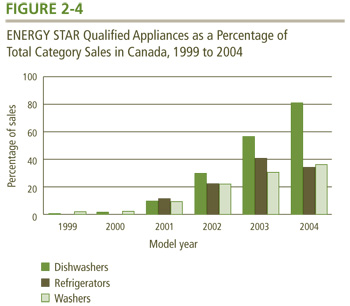
Continuous efforts to promote ENERGY STAR qualified appliances have paid off. Industry figures for 2004 show an increase in market penetration from almost nil in 2000 to 34 percent for refrigerators and 81 percent for dishwashers (see Figure 2-4). The increase in market penetration indicates growing acceptance of ENERGY STAR as the brand for high efficiency and the willingness of manufacturers to raise product offerings to qualifying levels. In this regard, ENERGY STAR specifications and levels are periodically updated as product saturation is reached to encourage industry to strive for more efficient products and thus maintain the relevance and credibility of the brand. Subsequent increases in qualifying levels for ENERGY STAR qualified products such as central air conditioners and heat pumps came into effect in 2006, and more stringent levels for clothes washers and dishwashers will come into effect in 2007.
ENERGY STAR is also well known in the commercial sector, with criteria for products ranging from office equipment to traffic signals. NRCan supports demonstration projects to validate the savings and other benefits of some of these products and address barriers to their widespread acceptance. One example is the department's support for the accelerated replacement and promotion of light-emitting diode (LED) exit signs for retrofit applications in Alberta. Exit signs operate around the clock; and for high-rise buildings, with a minimum of four signs per floor at approximately 25 watts per sign, these products represent a constant electrical draw and, therefore, an energy savings opportunity for building owners. The project objective was to target apartment building owners, stimulate demand for LED exit signs and increase awareness of the benefits of early replacement of standard incandescent exit signs with more efficient LED units consuming 5 watts per sign. The project also included recycling of the replaced units. The program influenced the conversion of 7311 incandescent exit signs with LED exit signs, yielding approximately 1.6 gigawatt hours per year of electricity savings, and 570 tonnes of carbon dioxide reductions. For all new installations, Canada's Energy Efficiency Regulations now require that exit signs meet the ENERGY STAR level of 5 watts per face.
Canada continues to promote ENERGY STAR guidelines for procurement officials. It has updated an interactive cost calculator that compares energy cost savings and GHG emissions reductions associated with the purchase of ENERGY STAR qualified products. A number of workshops were held across Canada, from Newfoundland and Labrador to Nunavut and the Northwest Territories, to make governments, institutions and city officials aware of the ENERGY STAR criteria and procurement tools. Canada is also working with housing agencies to help them identify energy savings in their properties and to specify ENERGY STAR qualified products at the time of replacement or retirement.
Canada continues to expand the types of products included in its ENERGY STAR agreement. For example, Canada recently included vending machines, commercial refrigeration, compact fluorescent lamps and commercial clothes washers in its exchange of letters with the United States government.
Key 2005-2006 Achievements
- Canada held its third annual meeting of ENERGY STAR participants and awarded plaques of recognition to nine forward-looking organizations, recognizing their commitment to producing, selling and promoting ENERGY STAR qualified products. Over 30 manufacturers and retailers were recruited as new ENERGY STAR participants, bringing the number to over 250 participants.
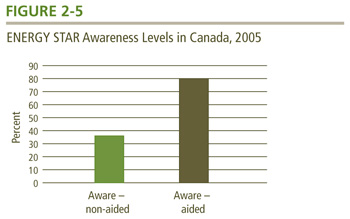
- Surveys on the awareness of ENERGY STAR have shown an increase in unaided awareness and understanding of the symbol. A survey of 2000 Canadians revealed that unaided awareness was 36 percent in 2005. Aided awareness of ENERGY STAR has reached 80 percent (refer to Figure 2-5). Recognition of ENERGY STAR has shifted from seeing the symbol on computer equipment to seeing it more often on major appliances.
- Market information submitted as part of the EnerGuide rating program for gas fireplaces shows that shipment of units with higher efficiency ratings has increased. In 2005, 85 percent of the units shipped ranged in efficiency from 50 to 69.9 percent. In 2004, 76 percent of the units shipped were in this efficiency range. In 2003, the percentage stood at 31 percent.