


Natural Resources Canada
www.nrcan.gc.ca
Common menu bar links
Office of Energy Efficiency Links
Personal: Residential
Menu
Improving Energy Performance in Canada – Report to Parliament Under the Energy Efficiency Act For the Fiscal Year 2005-2006
PDF VersionNext Page
Table of Contents
Chapter 5: Industry
Energy Use and Greenhouse Gas Emmissions
The industrial sector includes all manufacturing industries, all mining activities, forestry and construction; however, it excludes electricity generation. This sector uses energy in industrial processes as a source of motive power to produce heat or to generate steam. Overall, industrial energy demand accounts for 38.4 percent (3277 petajoules) of secondary energy use and 33.6 percent (170 megatonnes) of greenhouse gas (GHG) emissions (including electricity-related emissions).
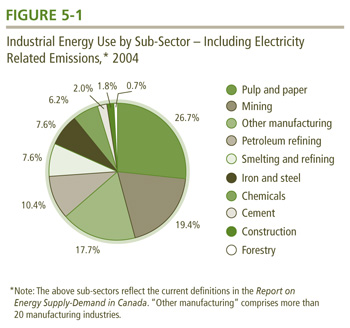
Within the industrial sector, energy is consumed primarily in pulp and paper, mining, petroleum refining, and smelting and refining industries. Pulp and paper alone accounted for about 26.7 percent of total industrial energy demand in 2004 (see Figure 5-1).
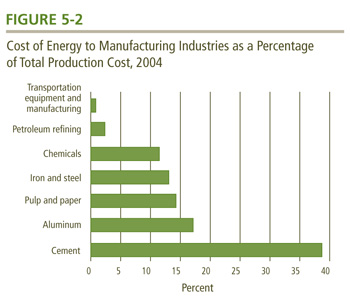
In most industries, energy purchases account for only a small proportion of total expenditures. However, for some relatively energy-intensive industries – cement, aluminum, pulp and paper, iron and steel, and chemicals – this share is higher than 11 percent (see Figure 5-2). For cement, in particular, the share is as high as 38.7 percent.
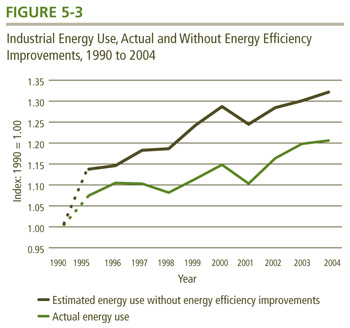
Actual industrial energy use increased by 20.6 percent (560 petajoules) between 1990 and 2004. This increase was driven by a 40.4 percent increase in industrial activity, measured as a combination of physical units of production, gross output and gross domestic product (GDP). However, some of this increase in energy use that would have resulted from the increase in activity was offset by improvements in energy efficiency and structural change – the shift to less energy-intensive industries (such as electrical and electronics).
Three main factors influenced energy use:
- activity – increases in physical units of production, gross output and GDP contributed to a 40.4 percent increase in industrial activity resulting in a 1098-petajoule increase in energy use.
- structure – the change in the mix of activity toward less energy-intensive industries resulted in a 224-petajoule decrease in energy use.
- energy efficiency – due to an 11.5 percent improvement in energy efficiency, the industrial sector avoided 314 petajoules of energy use between 1990 and 2004.
The change in energy use between 1990 and 2004 and the estimated energy savings due to energy efficiency are shown in Figure 5-3.
Between 1990 and 2004, industrial GHG emissions including electricity-related emissions increased by 19.7 percent. Excluding electricity-related emissions, industrial GHG emissions increased by 13.2 percent over the same period. Most of this increase in direct GHGs occurred in the upstream mining industry, since the mining (excluding upstream), manufacturing and construction industries realized a 2.7 percent decrease in GHG emissions.
Natural Resources Canada (NRCan) delivers initiatives to increase energy efficiency in the following components of the industrial sector:
- industrial processes and technologies
- equipment (refer to Chapter 2)
- buildings (refer to Chapter 4)
Industrial Processes and Technologies: Industrial Energy Efficiency (Canadian Industry Program for Energy Conservation [CIPEC] and Industrial Energy Innovators [IEI])
Objective: To help Canadian industry use energy efficiency investments to improve productivity and competitiveness and to contribute to Canada's climate change goals.
CIPEC is a unique industry-government partnership committed to promoting and encouraging energy efficiency improvements and reductions in GHG emissions through voluntary action across Canada's industrial sectors, including the mining, manufacturing, forestry, construction, upstream oil and gas, and electricity generation sectors.
CIPEC's network comprises 26 sector task forces (including four regional) that share information and best practices; more than 1000 Industrial Energy Innovators (companies that have made a written voluntary commitment to become more energy efficient and support Canada's climate change initiatives); and partnerships with 52 industry associations that disseminate information and advice on energy efficiency to their members.
CIPEC's multi-faceted approach focuses on introducing technological innovations, bringing about behavioural change, and shifting organizational culture to generate a sustainable market transformation. Tools and services offered through CIPEC include energy fora and conferences; communications products including Web sites and newsletters, technical guidebooks, energy benchmarking and best practices studies; Dollars to $ense energy management workshops; cost-shared energy audits and Process Integration studies; and provision of technical information relating to the eligibility of renewable energy and/or energy efficiency systems for accelerated capital cost allowances under Class 43.1 and Class 43.2 of the Income Tax Act.
Key 2005-2006 Achievements
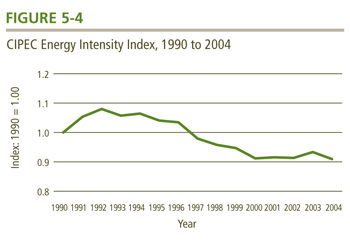
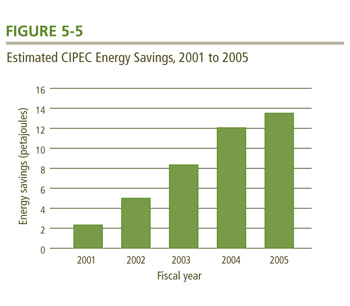
- Between 1990 and 2004, CIPEC industries improved their energy intensity by 9.1 percent and avoided 29.5 megatonnes of GHG emissions (see Figure 5-4). Adoption of CIPEC tools and services between 2001 and 2005 is estimated to have saved 13.5 petajoules in 2005 (see Figure 5-5).
- Recruited 338 new Industrial Energy Innovators, bringing the total number of facilities and companies registered to more than 1000. Initiated 221 industrial energy audits, which is more than double the target of 100 set for this Action Plan 2000 measure.
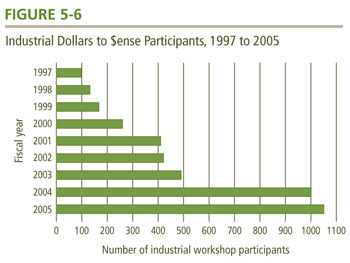
- As shown in Figure 5-6, 1051 industrial clients participated in Dollars to $ense energy management workshops. The jump between 2003 and 2004 was due to the significant increase in customized workshops.
For more information:
oee.nrcan.gc.ca/industrial/cipec.cfm
Industrial Processes and Technologies: Cleaner Fossil Fuel Power Generation
Objective: To design, develop and deploy technologies for power generation from fossil fuels with increased efficiency and reduction and ultimately elimination of emissions of acid rain precursors, GHGs, particulates and identified priority substances – mercury, trace elements and organic compounds.
Research focuses on improving performance of and reducing emissions from existing fossil fuel power plants and on developing new advanced cycles for conversion of fossil fuels to electricity with complete or nearly complete capture and elimination of carbon dioxide (CO2) and other emissions. Issues covered by other research projects include the transport and storage of CO2.
Key 2005-2006 Achievements
- Developed a coordinated and integrated approach to address opportunities and priorities related to industrial combustion processes with the potential to reduce energy use and emissions by between 15 and 50 percent. Government and industry players have shown considerable interest in participating.
- The U.S. Department of Energy has recognized the new Pressurized Gasification Laboratory as the world's foremost small pilot-scale research facility.
- Developed a new generation of computational fluid dynamics software, simulated 12 coal-fired boilers, and established training courses as part of an international collaborative venture to reduce CO2 emissions from utility boilers in China.
For more information:
www.nrcan.gc.ca/es/etb/cetc/cetc01/htmldocs/Groups/clean_electric_
power_generation_e.htm
Industrial Processes and Technologies: Processing and Environmental Catalysis Program
Objective: To solve industrial process problems and undertake research in areas with high potential for significant environmental and economic benefits.
The Program's facilities, including semi-pilot-scale plants, are used for process testing and the evaluation of novel concepts in chemical and energy conversion, including hydrogen production from hydrocarbon and renewable sources. Clients include oil and gas companies, petrochemical companies, engine manufacturers, waste oil recyclers and renderers, and specialty ceramic manufacturers.
Key 2005-2006 Achievements
- Developed technology for desulphurizing diesel fuel that is produced by thermally cracking waste lubricating oil. A bench-scale continuous processing unit was commissioned for testing the CANDES process. The project has support from the waste oil recycling industry.
- Completed catalyst evaluation for producing olefins by catalytic cracking of hydrocarbon feedstocks. Catalyst testing was conducted for Valeo, a technology development company with proprietary catalyst technology. The results will be used to secure industrial partnerships.
- Developed a direct ammonia fuel cell for efficient combined heat and power applications. Bench-scale fuel cell development is being undertaken by three federal labs.
For more information:
www.nrcan.gc.ca/es/etb/cetc/cetc01/htmldocs/Groups/Research%20
Programs/processing_and_environmental_catalysis_e.htm
Industrial Processes and Technologies: Industrial System Optimization Program
Objective: To support the development and adoption of innovative energy-efficient design practices in Canadian industry to improve energy efficiency and productivity while reducing GHG emissions and other environmental impacts.
The Program focuses on plant-wide industrial process analysis techniques, such as Process Integration (PI) and advanced process control systems, to identify and correct inefficiencies in plant operation and design with due consideration for energy, economy and environmental factors. It seeks to meet its objective by conducting leveraged research and development through national and international cooperation. Furthermore, the Program disseminates technical information to encourage adoption of these techniques and practices in targeted energy-intensive sectors of Canadian industry, including pulp and paper, oil upgrading and refining, petrochemicals, steel, chemicals, food and drink, and solid wood.
Key 2005-2006 Achievements
- NRCan designed, proposed and demonstrated a national PI program to publicize, promote and implement sound PI practices in the Canadian industry infrastructure (both large final emitter and non-large final emitter sectors). Under such a comprehensive program, GHGs would be reduced by an estimated 10 megatonnes of CO2 equivalent per year, businesses would become more competitive by reducing their energy and water expenditures resulting in annual energy-cost savings of about $1 billion, the implementation of identified savings would result in significant economic spin-offs of around $6 billion and a reduced environmental footprint, and Canadian industry stakeholders would be given the knowledge and tools needed to make PI standard practice in Canada. The program represents a major opportunity to change the way energy analysis is currently conducted in the industry, thereby improving productivity and competitiveness.
- Development of guidelines for Combined Energy and Water Optimization for the pulp and paper industry. A clear methodology was developed to identify and improve water and energy utilization in Kraft mills, with a novel approach to the analysis of non-isothermal mixing points, which can be a very significant source of energy losses in the pulp and paper industry. Also prepared an opportunity analysis document for projects around the site-wide energy and water optimization theme for the oil sands, based on successful experiences in the pulp and paper sector.
- Struck a partnership with the Natural Sciences and Engineering Research Council of Canada Environmental Design Engineering Chair and initiated an agreement with École Polytechnique de Montréal and several leading pulp and paper companies to create a unique body of expertise in the area of pulp and paper. The Chair's project is entitled "Optimizing the Carbon Value Chain in the Pulp and Paper Process Biorefinery." It will use its core competency in PI to evaluate how pulp and paper mills can evolve so that they not only survive but also prosper.
For more information:
cetc-varennes.nrcan.gc.ca/en/indus.html
Industrial Processes and Technologies: Industry Energy Research and Development (IERD) Program
Objective: To encourage and support the development and application of leading-edge, energy-efficient and environmentally responsible processes, products, systems and equipment in industry.
Financial support is provided for commercially confidential applied research and development (R&D) activities. The funds are repayable if the project is commercially successful. Program clients from all industrial sectors range from small- and medium-sized companies to multinational corporations.
Key 2005-2006 Achievements
- With the financial support of IERD, MagCasTec Inc. of Strathroy, Ontario, is developing an ingot preheater for the magnesium and aluminum casting industries that will preheat ingots with waste heat from the top of melting furnaces rather than electric heaters. It is projected that a preheater will reduce electricity consumption by 1.7 terajoules per year and GHG emissions associated with electricity generation by 94 tonnes per year. In magnesium casting applications, it is projected that each preheater will reduce sulphur hexafluoride consumption by 10 percent for a CO2 equivalent reduction of 28 000 tonnes per year.
- Mining Technologies International of Sudbury, Ontario, is developing an energy-efficient diesel/electric hybrid scoop tram for mining operations. This hybrid system alone could improve the air quality in the underground mine environment by a factor of 60 percent. Potential annual energy savings range from 824 gigajoules in the first year of commercialization to 272 terajoules in year 10. Cumulative savings are of the order of 1.4 petajoules over the same period.
- S.O.E. Inc. of St-Mathieu-de-Beloeil, Quebec, is developing a new toroidal, continuously variable transmission to increase the efficiency of diesel engines operating generator sets. Projected energy savings for genset application are 15 to 25 percent (setup-dependent), with an engine life increase of 25 percent. Potential energy savings over 10 years are 46 petajoules, with a CO2 reduction of 9.4 megatonnes.
For more information:
nrcan.gc.ca/es/etb/cetc/cetc01/htmldocs/Publications/ierdpublications/fact
sheet_industry_energy_r&d_e.htm
Industrial Processes and Technologies: Emerging Technologies Program (ETP)
Objective: To support the identification and demonstration of new and emerging energy-efficient technologies.
Projects are co-managed and cost-shared with industry and other stakeholders, such as gas and electric utilities, other governments and equipment manufacturers. Financial support is provided for the development and testing of pilot plants and prototypes and for full-scale field trials to evaluate operating performance, energy efficiency and environmental impacts. NRCan's financial support is repayable from any cost savings or revenues generated by a project.
Key 2005-2006 Achievements
- ETP supported Sirex Engineering of Bolton, Ontario, for the development and demonstration of an automated production line to recycle and convert postindustrial cross-linked polyethylene foam scrap into laminated sheet foam products. The process will save energy and will reduce GHG emissions by not having to make new foam. Emissions will be further reduced because incineration of scrap foam will be cut back, and there will be less pressure on landfills because less scrap will be transported to them.
- Groupe Énerstat of Bromptonville, Quebec, with contributions from ETP, completed a field trial of its phase-change thermal storage system in the chilled water plant at the IBM Canada Ltée. plant in Bromont, Quebec. The system reduced electrical annual energy and natural gas energy inputs for the plant by 19 terajoules for a combined energy savings of 46 percent and an estimated annual GHG emissions reduction of 232 tonnes.
- With the financial support of ETP, Custom Dry Kiln (CDK) of Port Coquitlam, British Columbia, was able to demonstrate that dehumidification lumber kilns were substantially more energy efficient than traditional lumber drying kilns when drying large quantities of softwood dimensional lumber (2.1 gigajoules per thousand board feet compared with 2.4 gigajoules per thousand board feet). Additionally, CDK showed that dehumidification kilns make it possible to capture a high proportion of volatile organic compounds (VOCs) released by the lumber in the condensate, leaving relatively low levels of VOCs in the kiln atmosphere.
For more information:
nrcan.gc.ca/es/etb/cetc/cetc01/htmldocs/funding_programs_etp_e.html
Industrial Processes and Technologies: Industrial Energy Innovation
Objective: To assist major industrial energy consumers to reduce the energy intensity of their operations and to reduce GHG emissions and emissions of other air pollutants, while enhancing competitiveness and profitability.
Industrial combustion processes are the major sources of industrial GHG emissions. Because most industrial furnaces operate at extremely low thermal efficiencies of 15 to 50 percent, there are major opportunities to improve industrial energy efficiency and productivity while significantly reducing GHG emissions.
NRCan's work in this area includes changing the interaction of the combustion system within the process through advanced tools and technologies. NRCan held technical workshops with major industry sectors (steel, mining, smelting and refining, cement, lime, and pulp and paper) and with CIPEC, industrial associations and individual companies to help define and map partnerships for a generic industrial combustion R&D program and applications to take advantage of these opportunities in order to achieve potential energy and GHG reductions of 10 to 50 percent and more. In addition, NRCan is engaged in developing generic tools and technologies that cross industry sectors, fuels and furnaces.
Key 2005-2006 Achievements
- Developed a computer model of a football-field-sized induration furnace and validated the model with field data. In doing so, identified the opportunity for major reductions in energy consumption (>50 percent) and comparable reductions in pollutant emissions, including GHGs, with the potential for dramatic operating cost savings.
- Using advanced laser-based flame analysis, developed a novel burner suitable for converting a large energy-intensive industrial glass furnace from expensive natural gas to waste petroleum coke, with no change in production or product quality. With successful adoption on one furnace, the client is now converting all of its furnaces using this concept.
- Developed a sophisticated computer model for flame visualization, using movie animation techniques, which will facilitate intuitive data analysis for performance enhancement and energy savings. The tool will enable rapid transfer and acceptance of computational fluid dynamic modelling results directly by plant and consulting engineers and equipment designers of industrial combustion facilities.
For more information:
www.nrcan.gc.ca/es/etb/cetc/cetc01/htmldocs/Groups/industrial_
innovation_e.htm
Industrial Processes and Technologies: Minerals and Metals Program
Objective: To reduce GHG emissions from Canada's minerals and metals sector by enhancing mineral and metal recycling processes and practices, by encouraging replacement of cement in concrete with supplementary cementing materials (SCMs), and by assessing alternate production processes.
The Minerals and Metals Program is managed by CANMET Mineral Technology Branch and is part of the Government of Canada Action Plan 2000 on Climate Change. This five-year program, which was assigned a GHG emissions reduction target of 1.65 million tonnes of CO2 equivalent per year by 2010, wrapped up in March 2006. It consisted of (1) the Enhanced Recycling component, which aims to increase Canada's potential to recycle all materials by developing new approaches and improving upon existing recycling infrastructure, practices and policies; and (2) the Enhanced Emission Reductions for Minerals and Metals component, which supports activities to increase the use of SCMs in concrete and thus replace portland cement (thereby reducing the GHG emissions of concrete production) and which examines processes to gain a greater understanding of them and thereby generate new emission reduction opportunities in the minerals and metals industry sector.
Key 2005-2006 Achievements
- As part of the wrap-up of the Enhanced Recycling Program, a two-day workshop was held in Ottawa to discuss the performance of the program and next steps, which involved providing input for a "National Strategy on Resource Recovery and Recycling." The workshop was attended by 65 experts from across Canada and a report was produced outlining key issues for future consideration.
- In partnership with Environment Canada and ICF Consulting, the Minerals and Metals Program supported the development of a study entitled Determination of the Impact of Waste Management Activities on Greenhouse Gas Emissions, which will be an important tool for decision-makers comparing the GHG implications of different end-of-life management strategies for materials found in the waste stream.
- The Association of Canadian Industries Recycling Coal Ash presented a cross-Canada series of workshops with a regional focus to demonstrate the latest information on the technical and performance benefits of SCMs in concrete, as well as new industry guidelines/standards and their significance for practices.
For more information:
recycle.nrcan.gc.ca
nrcan.gc.ca/mms/canmet-mtb/mtl/research/concrete_e.htm
Industrial Processes and Technologies: Mine Ventilation
Objective: To reduce energy consumption and GHG emissions associated with mine ventilation through infrastructure automation (to support demand-based delivery systems), ventilation network optimization and management, and less air-volume-demanding technology.
Ventilation is required in underground mines to maintain a safe working environment because it dilutes and removes harmful pollutants (dusts and gases) and provides a thermally suitable working climate. However, providing sufficient suitable ventilation can account for 40 percent of the energy consumed underground by a mining operation. Mine ventilation systems naturally include some redundancy to accommodate all the available production locations. The degree and implications of this oversupply are highly dependent on the individual mine, mineral and mining method. Metal mines that were traditionally designed to operate at maximum delivery – i.e. peak demand across all potential production locations 24 hours a day, 7 days a week – are now starting to adjust ventilation systems to match actual production needs. Energy savings at less than peak demand range from linear for the heating/cooling systems through to a cubic relationship for the primary fan system. Optimizing energy use, GHG emission reductions and cost is not a straightforward proposition, as it depends on the specific consumption profile (i.e. electricity versus heating fuels and primary versus secondary delivery systems), the design criteria and geographic location of each mine and therefore requires evaluation on a case-by-case basis.
Key 2005-2006 Achievements
- In order to assess potential cost, energy requirements and GHG reduction strategies, CANMET – Mining and Mineral Science Laboratories continued to develop a process-based modelling approach for determining ventilation needs as a function of the life of the mine. This will enable mine management to select, on an on-demand basis, the level of ventilation that is appropriate to support production and to dilute contamination. The same model could be used to better evaluate the benefit of various ventilation reduction options, such as fuel cells and other clean engine technologies. A model for one type of mine has been completed.
- The implementation of ventilation on demand at an Inco mine continues. The mine has installed monitoring information to track vehicle movement and energy usage, along with a proof-of-concept automated secondary ventilation system.
For more information:
nrcan.gc.ca/mms/canmet-mtb/mmsl-lmsm/mines/air/air-e.htm
